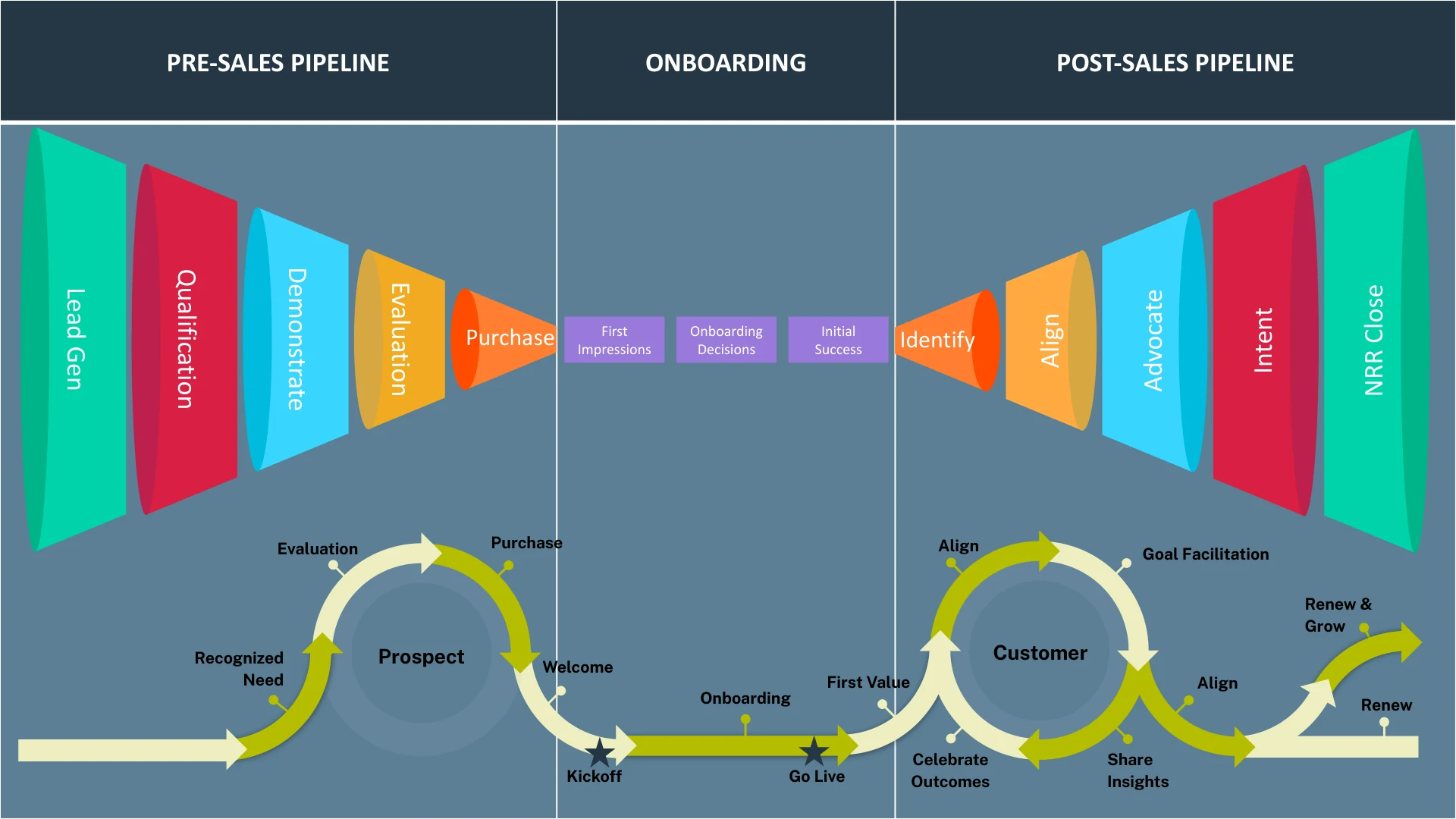
Identify surfaces opportunity. But seeing an opportunity and having the right to pursue it are not the same thing. Between the two sits a critical and frequently skipped step: understanding whether the opportunity actually fits. Not in the abstract sense of whether the product could help, but in the specific sense of whether this recommendation connects to what this customer is trying to accomplish, in this business, at this moment. That is what Align is about. It is the work of making an identified opportunity credible—grounded in the customer's actual goals, their real constraints, and the outcomes they care about enough to invest in.
Without that grounding, every recommendation feels like selling. It may be accurate. It may be well-intentioned. It may even be the right solution. But if it cannot be connected to something the customer has already said matters to them, it lands as a pitch. And a pitch, in a post-sale context, erodes exactly the trust that makes expansion possible.
An unaligned opportunity is not a pipeline entry. It is a guess. Align is the work of replacing that guess with a business case the customer recognizes as their own.
This is where many post-sale teams get the sequence wrong. They identify an opportunity—a use case, a new team, a product expansion, a premium tier—and move directly toward pitching it. The logic is understandable. The opportunity looks right. The customer seems satisfied. The timing feels reasonable. But none of that answers the question that actually determines whether the conversation will land. Does this recommendation connect to what the customer said they needed when they bought? Does it extend a goal they are actively working toward? Does it solve a problem they have named, or one the team has inferred?
If the answers are not clear, Align has not been done. And without it, the opportunity cannot move forward with confidence—because the case for it lives inside the vendor's thinking, not the customer's.
What Alignment Actually Requires
Alignment is not a conversation style. It is not a tone or a posture or a method of framing recommendations carefully. It is a substantive connection between an identified opportunity and the customer's specific context. That context has three components: their goals, their outcomes to date, and their use cases.
Goals are what the customer articulates as their reason for purchase. In a well-run kickoff, these are named explicitly: reduce processing time, increase team capacity, improve reporting visibility, consolidate vendors, accelerate a specific business initiative. These are not abstract aspirations. They are commitments the customer made to their own organization when they approved the investment. They are the lens through which every future recommendation must be filtered.
Outcomes are what the customer has actually experienced. First Value was a milestone. But by the time Align is relevant, there is a track record. There are things that worked, and things that did not. There are capabilities the customer adopted quickly and others they have not yet used. There are goals that are on track and others that have drifted. All of that is information. And when an opportunity can be anchored to the real outcomes the customer has already produced—or to the gaps between where they are and where they intended to be—it is no longer a pitch. It is a logical continuation.
Use cases are the specific ways the customer applies the product inside their organization. This is the operational layer. It reveals which teams are engaged, which workflows have been built, which problems are being solved in practice. It also reveals which use cases were discussed during the sale but never activated, which adjacent teams could benefit, and which future applications are natural extensions of how the customer works today. Use cases are what make an opportunity feel relevant to the person receiving it—because they recognize their own work in the recommendation.
If the customer cannot see themselves in the recommendation—their goals, their outcomes, their use cases—the opportunity is not yet aligned. It is still yours, not theirs.
Why Generic Business Cases Fail
Most expansion conversations fail not because the product is wrong, but because the business case is generic. It relies on category-level proof points—what the product does for companies like this customer, rather than what it has done for this customer. It references ROI frameworks that were never calibrated to the customer's actual numbers. It describes capabilities in terms of what the product can do, not in terms of what the customer is trying to accomplish.
A generic business case can be technically accurate and completely unconvincing. Because the customer is not evaluating the product in the abstract. They are evaluating whether this next investment is worth the cost, the disruption, the organizational effort, and the political capital it requires to approve. And that evaluation happens through a very specific lens: does this connect to what we said we needed, and does it move us meaningfully closer to it?
A well-aligned business case answers that question directly. It shows the customer their own goals reflected back to them, updated with the progress they have made and the gaps that remain. It identifies the use case or expansion not as a new product, but as the logical next step in a journey they are already on. It quantifies the connection to outcomes they have already started to realize. And it makes the path forward feel like continuation, not acquisition.
That is a fundamentally different ask than a pitch. And it produces a fundamentally different response.
Alignment Requires Staying Engaged
The practical problem with Align is that it requires knowledge the team may not have if the relationship has been managed reactively. Goals stated at kickoff drift as businesses evolve. Priorities shift. New leaders enter. Old initiatives are replaced. A recommendation that would have been compelling six months ago may be irrelevant today—not because the product changed, but because the customer's context did.
This is why Align is not a one-time activity. It is an ongoing discipline of keeping the team's understanding of the customer current. That means staying engaged enough to notice when goals shift, when new use cases emerge, when organizational changes create new stakeholders, and when the distance between where the customer is and where they intended to be begins to close—or to widen.
Staying engaged does not mean scheduling more meetings. It means asking better questions, more consistently. It means treating every interaction as an opportunity to update the team's understanding of what matters and why. And it means documenting that understanding in a way that survives personnel changes, handoffs, and the natural entropy of a busy post-sale operation.
Alignment is not something you establish at kickoff and revisit at renewal. It is the ongoing work of keeping your understanding of the customer's goals, outcomes, and use cases current enough to make recommendations that land.
When that discipline is present, something changes in how opportunities are evaluated. They stop being items on a pipeline report and start being conversations the team is genuinely prepared to have. The CSM does not walk into an expansion discussion hoping the customer will see the relevance. The relevance is already documented, already validated in prior conversations, already connected to goals the customer has confirmed are still live. The recommendation does not arrive as a surprise. It arrives as a next step.
The Business Case Is the Output
What Align produces is a business case. Not a deck. Not a proposal. A clear, grounded explanation of why this specific opportunity makes sense for this specific customer, in language that reflects their goals and is anchored to their actual experience with the product so far.
That business case has to answer four questions before it is ready to move to the next stage. First: what is the customer trying to accomplish, and is that goal still current? Second: what progress have they made toward that goal, and what remains? Third: how does this opportunity directly advance that goal, using use cases the customer already understands? And fourth: what does success look like if this works—in terms the customer would recognize and their organization would value?
When all four can be answered clearly, the opportunity is aligned. The team knows it is not pitching. The recommendation is grounded in something real. And the conversation that follows is not about convincing the customer—it is about deciding together whether now is the right time to move forward.
There is one more thing the business case must do: it must be portable. The person the team has been working with most closely may not be the person who makes the decision. They are rarely the only person whose support matters. The business case has to be simple enough, specific enough, and well-evidenced enough that the customer's own people can carry it internally without the vendor in the room. That portability is not a nice-to-have. It is a requirement. Because if the business case can only survive when the CSM is present to explain it, the opportunity has not yet been aligned to the customer's organization. It has only been aligned to the contact.
If your primary contact cannot explain the business case to their leadership without you present, Align is not finished. A recommendation the customer cannot carry is a recommendation that will not move.
What Align Enables
Done well, Align changes the nature of the relationship at a critical moment. The customer stops experiencing the vendor as someone who manages the existing engagement and starts experiencing them as someone who understands the business well enough to see what comes next. That shift matters because it is the foundation of what has to happen in Advocate.
Advocate requires the customer to carry the opportunity internally. That only happens when the customer's own people believe in the business case—not because the vendor made it sound compelling, but because it reflects something they already know to be true about their own organization, their own goals, and the value they have already started to see. Advocacy built on a generic business case is fragile. Advocacy built on alignment is durable.
This is why the order matters. Identify without Align produces pipeline noise—opportunities that look real but are not yet grounded. Align without Identify produces effort without direction—the team is building business cases for things the customer does not yet see as opportunities. Together, they create the conditions for an expansion conversation that the customer wants to have. Not because the vendor asked for it. Because the customer can see, clearly and specifically, why it makes sense for them.
That is the outcome Align is designed to produce. A recommendation that belongs to the customer as much as it belongs to the team. A business case the customer recognizes, can defend, and is willing to carry. And a shared understanding that the next step is not a favor the customer is doing for the vendor—it is a decision that serves the customer's own goals, measured by their own outcomes, and grounded in the work they have already done together.
An account advances from Align to Advocate through play completion, not through elapsed time or assumed progress. When the Sharing Insights play delivers evidence the customer can carry internally, and when the Alignment Meeting play produces a documented business case tied to the customer's own goals — those completions are logged, and together they signal that the opportunity is grounded enough to move. The pipeline does not advance because alignment feels strong. It advances because the plays that create alignment have been executed and recorded.